CS2 Skin Rarity Explained: Why It Doesn’t Always Predict Price (2026)
By Ryxens · Published · Updated
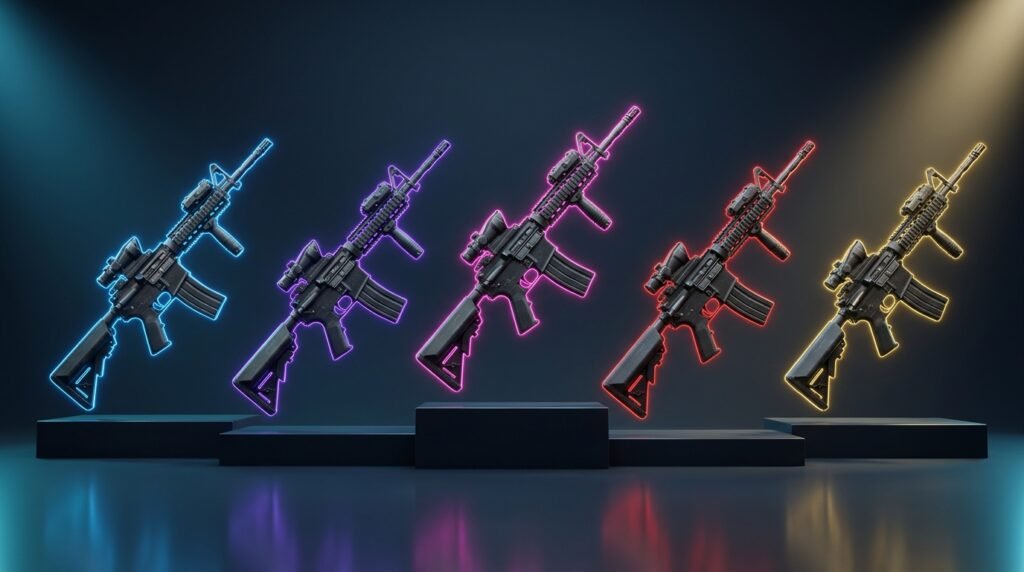
Short answer: rarity tier is supposed to predict price. Valve’s own case odds back that up: Covert drops just 0.64% of the time versus Mil-Spec’s 79.92%, so a Covert should cost more than a Mil-Spec almost by definition. In practice it often doesn’t. Across the weapons covered on this site, at least nine have a skin from the “wrong” tier outpricing where it’s supposed to sit, MP9’s only Covert skin is the cheapest of its three most notable skins, while a 2013-era Restricted skin on the same weapon sells for over $1,000. The pattern isn’t random: it almost always traces back to a skin’s age, its origin outside the case system, or a discontinued container, not a flaw in the rarity system itself.
How CS2 rarity is supposed to work
Answer: seven tiers, each with its own color and (for weapon cases) a fixed drop percentage that never changes between cases.
| Rarity | Color | Case drop odds |
|---|---|---|
| Consumer Grade | White/grey | Not part of the standard case pool |
| Industrial Grade | Light blue | Not part of the standard case pool |
| Mil-Spec Grade | Blue | 79.92% |
| Restricted | Purple | 15.98% |
| Classified | Pink | 3.2% |
| Covert | Red | 0.64% |
| Extraordinary (knives/gloves) | Gold | 0.26% |
Those odds are identical across every case Valve has released, see our CS2 cases guide for the full breakdown and current ROI by case. For the complete rundown on float, StatTrak, and pattern seed stacking on top of rarity, see our what are CS2 skins beginner guide. This page focuses on one specific question those two don’t answer directly: does the tier a skin sits in actually predict what it sells for?
Why some low-rarity skins cost more than Coverts
Answer: almost every case where rarity breaks down traces back to one of three things: the skin predates the case system, it never came from a case at all, or its case has been discontinued long enough that scarcity took over.
Notice that Consumer Grade and Industrial Grade aren’t in the standard drop-odds table above at all. That’s not an oversight, it’s the actual explanation for most of this pattern. A huge share of the skins that break the rarity-price relationship are old enough that they were never subject to those percentages to begin with. MP9 Bulldozer and Five-SeveN Candy Apple both date to August 2013’s Arms Deal update, before the weapon case system existed in its current form, and both are Restricted or Industrial grade skins trading for hundreds of dollars. MP7 Groundwater and Orange Peel are the same story a few weeks later, September and November 2013, Consumer and Industrial grade, both reaching $50-176 in Factory New. None of these skins ever rolled a 0.64% Covert chance or a 79.92% Mil-Spec chance, they simply aren’t part of that lottery.
The second cause is collection-only origin: skins that were never sold in a case, only through map-based collections or souvenir packages tied to specific tournaments. Desert Eagle Blaze and P250 Nuclear Threat both fall here, neither ever dropped from a case, and both outprice Covert-tier skins on their own weapons as a direct result of that closed, one-time supply. The third cause is simple scarcity after discontinuation: a case stops circulating in new drops but stays tradable forever, and if the community still wants a specific finish from it, the price climbs regardless of what rarity tier Valve originally assigned it.
The skins that break the rule, weapon by weapon
Answer: nine weapons on this site have at least one documented rarity-price inversion, ranging from a single outlier skin to a near-total reversal of the expected order.
| Weapon | What breaks the pattern |
|---|---|
| MP9 | Covert skin is the cheapest of its three most notable skins; a Restricted skin sells for $1,000+, a Classified for $1,700-2,800+ |
| MAC-10 | A Classified skin, Hot Snakes, outprices both of the weapon’s Covert skins |
| Tec-9 | No Covert skin exists at all, yet its priciest skin, a Restricted, reaches roughly $896 |
| FAMAS | Covert rarity spreads across three separate skins from three separate cases instead of one |
| Galil AR | A single decade-old Restricted skin ranges $16 to $200-plus purely on pattern and wear |
| Desert Eagle | Blaze, a Restricted collection-only skin, outprices every Covert the weapon has |
| P250 | Nuclear Threat, a Restricted souvenir-only skin, reaches hundreds of dollars with no case origin |
| Five-SeveN | Candy Apple, only Industrial grade, rivals the weapon’s cheaper Covert despite sitting three tiers below it |
| MP7 | Two Consumer/Industrial skins from 2013 meet or exceed the weapon’s actual Covert grail, the closest race on the site |
See the full pricing and sourcing behind each of these in our best CS2 MP9 skins, best CS2 MAC-10 skins, best CS2 Tec-9 skins, best CS2 FAMAS skins, best CS2 Galil AR skins, best CS2 Desert Eagle skins, best CS2 P250 skins, best CS2 Five-SeveN skins, and best CS2 MP7 skins rankings.
Where rarity actually holds up
Answer: not every weapon breaks the pattern. MP7 and Five-SeveN both show the system working close to as intended, just with a genuine complication in the details.
MP7’s Covert grail, Bloodsport, really is close to the weapon’s most expensive skin, exactly what the rarity system predicts, except that two ancient low-rarity skins get close enough to make it a real contest rather than a foregone conclusion. Five-SeveN goes further: both of its two Covert skins genuinely hold their position as the weapon’s priciest options, with only one Industrial-grade skin, Candy Apple, coming close. These two function as useful control cases, proof the rarity-price relationship isn’t broken everywhere, just unreliable enough that you shouldn’t assume it holds without checking.
Cheapest Classified-rarity skins worth knowing about
Answer: Classified sits two tiers below Covert and usually costs noticeably less, but not always as little as its rarity alone would suggest, some Classified skins stay genuinely cheap.
MP7 Abyssal Apparition, Classified from the January 2022 Dreams & Nightmares Case, runs $5.37-15.95. MP7 Nemesis, also Classified, from the May 2015 Falchion Case, covers $6.35-21.05. Both sit well under what most Classified-tier skins command, useful if you want the visual rarity marker without paying Covert-adjacent prices, see our best CS2 MP7 skins guide for the rest of that weapon’s lineup. Contrast that with MP9’s Wild Lily, also Classified, which sells for $1,700-2,800+, a reminder that “Classified” alone tells you almost nothing about where a specific skin will land.
FAQ
Does CS2 skin rarity determine price?
Not reliably. Rarity sets the odds of pulling a skin from a case, but price is set by the market. At least nine weapons covered on this site have a lower-rarity skin outpricing a higher-rarity one, usually because of age, collection-only origin, or a discontinued case.
Why do some Consumer and Industrial grade skins cost hundreds of dollars?
Most of the time it’s age. Skins from August-November 2013, before the modern case system existed, were never subject to the standard drop odds and can carry souvenir or historical demand that has nothing to do with their rarity tier.
What’s the CS2 rarity order from lowest to highest?
Consumer Grade, Industrial Grade, Mil-Spec Grade, Restricted, Classified, Covert, with Extraordinary reserved for knives and gloves above all of those.
What are the official CS2 case drop odds by rarity?
Mil-Spec 79.92%, Restricted 15.98%, Classified 3.2%, Covert 0.64%, and Rare Special Item (knives and gloves) 0.26%. These odds are identical across every case Valve has released.
Which CS2 weapon has the biggest gap between rarity and price?
MP9. Its only Covert skin, Starlight Protector, is the cheapest of its three most notable skins, while a Restricted skin from 2013 and a Classified skin from 2019 both sell for many times more.
Where to go next
See our what are CS2 skins beginner guide for the full rundown on float, StatTrak, and pattern seed, our CS2 cases guide for current case ROI and the full official odds table, and our best CS2 MP9 skins ranking for the single biggest rarity-price inversion on the entire site.
Play responsibly. Skin gambling is only for adults (18+/21+ depending on your region) and may not be legal where you live. Skins have real monetary value, never wager more than you can afford to lose. Get help at BeGambleAware.org.